
DFE parametrizations#
The DFE needs to be parametrized in some way in order to be amenable to maximum likelihood estimation. GammaExpParametrization is used by default. Other parametrizations are also implemented (cf. parametrization). You can also create your own parametrization by subclassing Parametrization.
To see how the parametrization affects the shape of the DFE, we use our example data for B. pendula.
library(fastdfe)

# load the fastdfe package
fd <- load_fastdfe()
# set logging level to only show very important messages
fd$logger$setLevel("FATAL")

# the different DFE parametrizations
parametrizations = c(
    fd$GammaExpParametrization(),
    fd$DiscreteParametrization(),
    fd$GammaDiscreteParametrization(),
    fd$DisplacedGammaParametrization()
)

inferences <- vector("list", length = 4)

for(i in seq_along(parametrizations)) {
    # create inference object
    inference <- fd$BaseInference(
        sfs_neut = fd$Spectrum(c(177130, 997, 441, 228, 156, 117, 114, 83, 105, 109, 652)),
        sfs_sel = fd$Spectrum(c(797939, 1329, 499, 265, 162, 104, 117, 90, 94, 119, 794)),
        model = parametrizations[[i]],
        do_bootstrap = TRUE
    )

    # run inference
    inference$run()

    inferences[[i]] <- inference
}

# set plot size
options(repr.plot.width = 6, repr.plot.height = 3)

# plot the inferred DFEs
p <- fd$Inference$plot_discretized(
    inferences = inferences,
    labels = c("GammaExp", "Discrete", "GammaDiscrete", "DisplacedGamma")
)
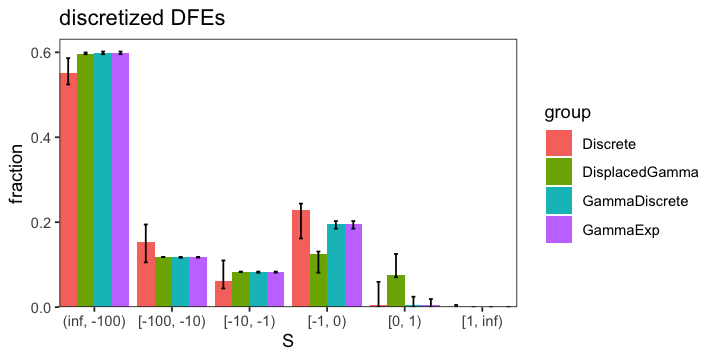
The shape is rather similar overall, but DiscreteParametrization appears to have larger confidence intervals.