
Quickstart#
Basic inference#
The easiest way to get started is by using the BaseInference class which infers the DFE from a single pair of frequency spectra, one neutral and one selected. In this example we create Spectrum objects holding the SFS counts and pass them to BaseInference. Note that we are required to specify the number of monomorphic sites (the last and first entries of the specified counts which correspond to the number of mono-allelic sites where the ancestral and derived allele is fixed, respectively).
import fastdfe as fd

inf = fd.BaseInference(
    sfs_neut=fd.Spectrum([177130, 997, 441, 228, 156, 117, 114, 83, 105, 109, 652]),
    sfs_sel=fd.Spectrum([797939, 1329, 499, 265, 162, 104, 117, 90, 94, 119, 794])
)

# run inference
inf.run();
INFO:Discretization: Precomputing linear DFE-SFS transformation using midpoint integration.
Discretization>Precomputing: 100%|██████████| 9/9 [00:00<00:00, 46.56it/s]
BaseInference>Performing inference: 100%|██████████| 10/10 [00:00<00:00, 16.20it/s]
WARNING:Optimization: The MLE estimate is close to the upper bound for {} and lower bound for {all.p_b: (0, 0, 0.5)} [(lower, value, upper)], but this might be nothing to worry about.
INFO:BaseInference: Successfully finished optimization after 62 iterations and 450 function evaluations, obtaining a log-likelihood of -34.63216290436293.
INFO:BaseInference: Inferred parameters: {all.S_d: -9868.112222890215, all.b: 0.15081009477849364, all.p_b: 0.0, all.S_b: 0.0010478204324131362, all.eps: 0.006854711964659445}.
fastDFE uses maximum likelihood estimation (MLE) to find the DFE. By default, 10 local optimization runs are carried out to make sure a reasonably good global optimum has been bound. The DFE furthermore needs to parametrized where GammaExpParametrization is used by default.
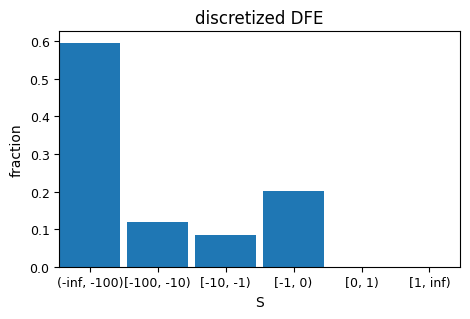
We can now plot the inferred DFE in discretized form (cf. plot_discretized()).
inf.plot_discretized();
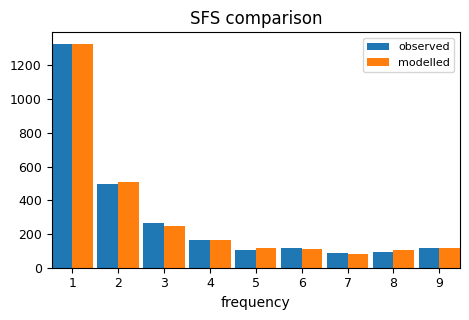
We can also plot a comparison of the (selected) modelled and observed SFS (cf. plot_sfs_comparison()).
inf.plot_sfs_comparison();
Bootstrapping#
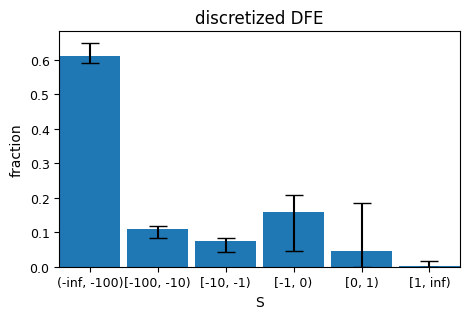
We can perform parametric bootstrapping (cf. bootstrap())
inf.bootstrap(n_samples=100)

# redo the plotting
inf.plot_discretized();
BaseInference>Bootstrapping: 100%|██████████| 100/100 [00:01<00:00, 62.17it/s]
Serialization#
# save the inference object to the file
# we can unserialized the inference by using BaseInference.from_file
inf.to_file("out/serialized.json")

# alternatively we can also save a summary to file
inf.get_summary().to_file("out/summary.json")